


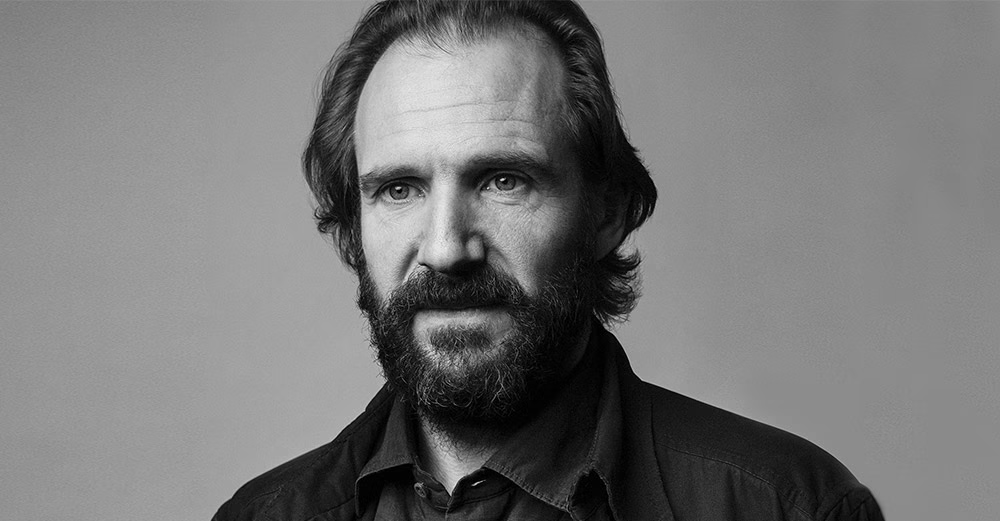
Ralph Fiennes stands as one of the most prominent figures in British acting, bridging the traditions of English theater and the demands of Hollywood cinema. The discipline derived from years on the Royal stages has transformed him into an actor capable of exploring the hidden layers of characters with precision and depth. Fiennes has demonstrated his skill not only in portraying complex villainous roles, such as Amon Goeth in Schindler’s List, but also in embodying tragic lovers, like Count Almásy in The English Patient. This duality signifies his broad artistic range, rooted in classical training and infused into modern cinema. Fiennes’ unique position lies in linking Shakespearean theater to cinematic visual tools, thereby creating a dramatic authority that transcends genre boundaries. This approach distinguishes him from purely commercial actors and emphasizes a legacy that prioritizes artistic quality.
✅ Roots and Formation of Artistic Character
Fiennes’ aristocratic lineage, tracing back to the Twisleton-Wykeham-Fiennes family, provided an intellectual backdrop for his artistic growth. His mother, Jennifer Lash, as a novelist, and his father, Mark Fiennes, as a photographer, created a cultural environment in the family that introduced art as an integral part of life. This setting, along with siblings active in artistic fields, directed Fiennes toward discovering his dramatic talents.
His academic education at the Royal Academy of Dramatic Art (RADA) marks a pivotal point in shaping his artistic character. This prestigious institution, with its focus on classical techniques, prepared Fiennes for theater stages. After graduation, he joined the Royal National Theatre and showcased his skill in interpreting Shakespearean texts in productions like Hamlet and Macbeth. This period, prior to entering cinema, turned him into a theater star and provided a solid foundation for his analytical approach to roles. The emphasis on dialogue and body language in theater later reflected in his cinematic works, making him an actor capable of conveying psychological depth without external aids. These roots not only shaped his career but also influenced his project selections that favored artistic aspects over commercial ones.
✅ The Nineties: Emergence of a Dramatic Phenomenon
The 1990s represent a period of emergence for Ralph Fiennes as a dramatic phenomenon in cinema, where his theatrical techniques aligned with the visual demands of film. The turning point of this decade was his role as Amon Goeth in Schindler’s List (1993) directed by Steven Spielberg. Goeth, as the Nazi camp commander, was depicted not merely as a symbol of historical evil but as an embodiment of human complexities in villainy. Fiennes, using piercing gazes and controlled movements, added layers of fragility and power to the role that went beyond usual stereotypes. This performance earned him an Academy Award nomination for Best Supporting Actor and a BAFTA award, eliciting praise from critics.
Fiennes’ striking shift in The English Patient (1996) directed by Anthony Minghella highlighted his acting range. In the role of Count Almásy, a tragic lover entangled in a forbidden romance amid World War II, he transitioned from absolute villainy to emotional depth. This role, which brought another Oscar nomination, demonstrates Fiennes’ ability to manage internal character conflicts. His technique in expressing emotions through silence and gaze, rooted in theatrical training, turned the film into a multilayered work. This decade introduced Fiennes as a distinctive actor capable of portraying diverse roles with analytical depth, without resorting to exaggeration. His works in this period laid the foundation for his continued career in various genres and emphasized the importance of artistic choices.
For a summary of key roles in this decade, the following table is provided:
| Film | Year | Role | Achievements |
|---|---|---|---|
| Schindler’s List | 1993 | Amon Goeth | Oscar Nomination, BAFTA Award |
| The English Patient | 1996 | Count Almásy | Oscar Nomination |
✅ Icon of Popular Culture: From Wizardry to Espionage
Ralph Fiennes has become an icon in popular culture, injecting dramatic depth into major franchises. His role as Lord Voldemort in the Harry Potter series (from 2005 to 2011) presented technical challenges, including heavy makeup and nose removal, which emphasized vocal delivery and body language. Fiennes, using a reptilian voice and serpentine movements, instilled fear not through appearance but from the psychological depth of the character. This approach transformed the role from a simple villain to a multilayered symbol of power and vulnerability, enhancing the series’ global popularity.

Fiennes’ entry into the James Bond franchise, from Skyfall (2012) to No Time to Die (2021), as M, replaced Judi Dench. He added bureaucratic dignity to the character, turning it into a symbol of administrative authority amid espionage chaos. Fiennes’ focus on precise dialogue and strategic gazes elevated the role beyond a mere manager, adding analytical depth. These choices demonstrate his ability to maintain artistic prestige even in commercial projects and introduce general audiences to technical aspects of acting.
✅ Author and Director: Beyond the Camera
Ralph Fiennes, beyond acting, as an author and director, has transferred his theatrical experiences to cinema. The film Coriolanus (2011), an adaptation of Shakespeare’s tragedy, was his first directorial experience where he also played the lead role. This work, focusing on dialogue and actors, recreated theatrical space in the cinematic frame and examined themes of power and betrayal in a modern language.
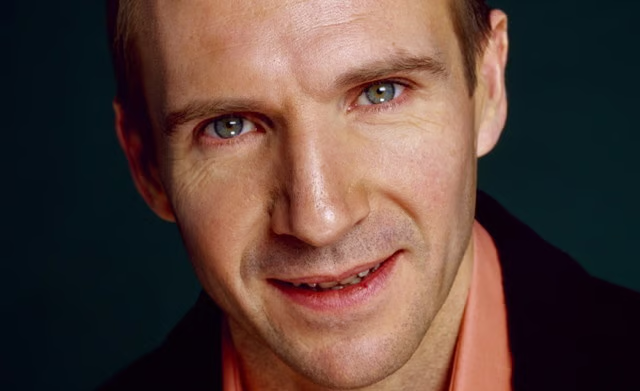
His next film, The Invisible Woman (2013), based on Charles Dickens’ life, highlighted Fiennes’ stylistic approach. In this work, he emphasized human relationships and emotional depth, utilizing his stage experiences to guide actors. This approach, prioritizing dialogue and actor performance, is rooted in classical training and turns films into analytical works. With these projects, Fiennes showed he can apply his artistic vision from behind the camera and emphasize the importance of literary adaptations in contemporary cinema.
✅ Private Life and Conclusion
Ralph Fiennes, maintaining his privacy, has distanced himself from social media and focused on humanitarian activities. As a UNICEF ambassador, he has participated in campaigns to support vulnerable children, considering this aspect part of his artistic commitment.
Fiennes’ legacy introduces him as one of the last survivors of the British method actors’ generation who have prioritized artistic quality over commercial fame. His analytical and multilayered approach has enriched modern cinema and provided a model for future generations.
✅ Related Articles
For further reading on prominent Hollywood actors, you can refer to the biography of Chris Hemsworth and Carrie Fisher.
✅ Frequently Asked Questions
What was Ralph Fiennes like in his youth? Ralph Fiennes was born on December 22, 1962, in Ipswich, England, as the eldest child of an artistic family; his father was a photographer and farmer, and his mother a novelist. The family moved to Ireland in 1973, and he studied at Chelsea College of Art before joining RADA to form the basis of his artistic foundation.
How did Ralph Fiennes play the role of Voldemort? Ralph Fiennes portrayed Lord Voldemort from 2005 to 2011 in the Harry Potter series, using heavy makeup, body language focus, and a reptilian voice to turn the character into a multilayered symbol of power and vulnerability. This approach induced fear through psychological depth.
What are Ralph Fiennes’ films? Ralph Fiennes has appeared in films such as Schindler’s List (1993), The English Patient (1996), Harry Potter series (2005-2011), Skyfall (2012), The Grand Budapest Hotel (2014), Coriolanus (2011), The Invisible Woman (2013), Conclave (2024), and 28 Years Later (2025). He also featured in Quiz Show (1994), The Constant Gardener (2005), and In Bruges (2008).
What is Ralph Fiennes’ role in Harry Potter? Fiennes played Lord Voldemort in the Harry Potter series starting from Goblet of Fire (2005), emphasizing psychological depth and serpentine movements to make the role one of cinema’s most enduring villains. His performance induced fear without relying on appearance.
How was Ralph Fiennes’ role in Schindler’s List? In Schindler’s List (1993), Fiennes played Amon Goeth, the Nazi commander, depicting human evil with layers of fragility. This role earned him an Oscar nomination for Best Supporting Actor and a BAFTA award.
What are Ralph Fiennes’ awards? Fiennes has been nominated for the Oscar three times (Schindler’s List 1993, The English Patient 1996, Conclave 2024) and won a BAFTA for Schindler’s List, a Tony for Hamlet (1995), and Outstanding Performer of the Year at SBIFF 2025. He has also received NSFC nominations for Conclave and multiple Golden Globe and Satellite awards, but no Oscar win.
Does Ralph Fiennes have Instagram? Yes, Ralph Fiennes has an official Instagram account under the username @ralphfiennesactor, sharing posts like behind-the-scenes of 28 Years Later (2025). He previously avoided social media but is now active.
Who is the actor playing Voldemort? The actor playing Lord Voldemort in the Harry Potter film series is Ralph Fiennes, who portrayed the role from 2005 to 2011. Using theatrical techniques, he elevated the character beyond a simple villain.


